City Car Driving Drift Games
- 4.0
- Rating
- 1.00M
- Installs
- Free
- Price

 Analysis by App-foxy
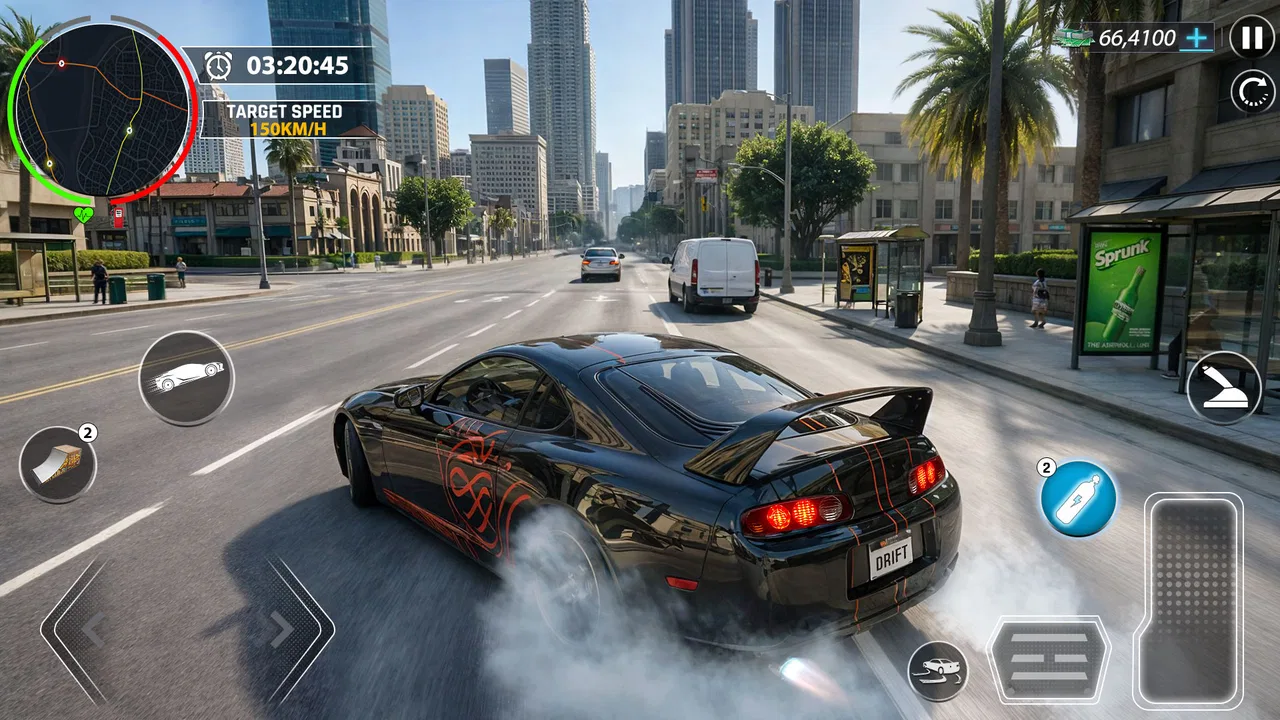
I approached City Car Driving Drift Games as a casual racing game rather than a full driving simulator, and that distinction matters. Its appeal is immediate: you get behind a virtual car, enter an urban setting, and focus on steering, movement, and drifting without needing to learn a complicated control scheme first. The store summary points to realistic city driving and smooth controls, but my interest is really in how that promise works during ordinary play: whether the car feels manageable, whether speed remains readable, and whether the game stays enjoyable after the first few sessions.
Gaming Mob presents this as a free game for Android, with a general Everyone age rating. It belongs to the racing category, although its city-driving and drifting emphasis gives it a slightly different rhythm from a traditional lap-based racer. You are not simply chasing a finish line every few seconds. The attraction is the sensation of moving through a city, setting up a turn, and trying to keep control when the car begins to slide.
The best way to think about it is as an accessible driving playground for short sessions. It may suit someone who wants a quick car game during a break, especially if complicated simulation menus or competitive multiplayer systems feel unnecessary. On the other hand, players looking for deep vehicle tuning, a large career structure, or highly demanding racing competition should keep their expectations measured.
You May Also Like

 Blood Strike: 2.5 Anniversary
Blood Strike’s Loadouts Turn Every Drop Into a Tactical Gamble
A close look at Blood Strike’s custom loadouts: how fast access to signature weapons reshapes its battle royale rhythm, rewards preparation, and narrows the gap between fights.

 Pandora - Music & Podcasts
Pandora’s Music Is Easy to Start, but Harder to Recover
Pandora’s strength is its low-effort path from a seed to a station. Its weak spot is how much confidence it asks you to place in connection, setup, and quiet recovery.

 8 Ball Pool
 Is Built on Rivalries, Rematches, and Routine
A close look at the rivalries, rematches, shared routines, and unanswered safety questions that turn a quick pool match into a persistent mobile community.

 Samsung Music
’s Quiet Strength Is Playing What You Already Own
Its reach comes less from spectacle than from dependable access to a personal library. That simplicity is both the app’s strongest retention engine and its ceiling.

 AccuWeather: Weather Radar
AccuWeather Review: A Quick, Clear Forecast for Everyday Decisions
For everyday plans, the best forecast is the one you can understand quickly. AccuWeather makes rain timing, radar, and local conditions easy to act on, with a few trade-offs.

 Hill Climb Racing
Why Hill Climb Racing Still Turns Crashes Into One More Run
A tiny car, a bumpy hill and one more upgrade: Hill Climb Racing keeps resurfacing because its simple chaos makes every near-miss feel personal.
More From Our News Desk
View All News


How the driving feels when speed starts to matter
I judge speed in a city racer by whether I can read a turn early enough to make a deliberate choice, not by how fast the car seems in a straight line. In this section, I’m looking at how steering and drift attempts change as pace rises, and why easing into a corner can be more useful than trying to force a dramatic slide.
Easy entry, with drifting as the main test
The first thing I noticed about this kind of design is that smooth controls matter more than a long list of features. City driving can feel awkward when steering reacts too sharply, while drifting becomes frustrating if the car loses control without warning. Here, the central challenge is finding a comfortable rhythm between ordinary turns and deliberate slides. I would begin with gentle steering rather than immediately forcing a drift, because that gives a better sense of how much correction the car needs.
That approach also makes the game more approachable for younger players and for anyone who does not regularly play racing games. The Everyone rating supports that broad audience, but it does not mean every player will enjoy the same level of challenge. A beginner may appreciate the forgiving entry point, while an experienced racing fan may find the driving less demanding than a dedicated simulator.
Perceived speed is especially important in a city environment. Narrow streets, nearby buildings, and frequent turns can make a moderate pace feel faster than it really is. I found that the most satisfying moments come from preparing for a bend instead of simply holding the accelerator and hoping the car stays aligned. Braking or easing off before the turn, then using a controlled steering input, usually feels more rewarding than making a last-second correction.
Why the city setting changes the experience
A city layout gives the game a different use case from a standard circuit racer. On a track, I expect to memorize a clean sequence of corners and improve lap times. In a city-driving game, my attention shifts toward positioning, avoiding awkward contact with the surroundings, and keeping the car pointed in the direction I want. That makes the experience feel more relaxed when I am exploring, but more demanding when I try to maintain a drift through several connected turns.
This is also where the game can appeal to players who enjoy car control more than formal racing. If your idea of fun is practicing a turn repeatedly until the car feels predictable, the urban setting gives you a reason to keep experimenting. If you need opponents, rankings, and a clear competitive target every time you play, the usual arcade racer may be a better match.
A practical rhythm for short sessions
My preferred routine would be a quick session after a commute or during a few spare minutes. I would start slowly, use the first turns to settle into the controls, and then attempt more ambitious drifts once the steering feels familiar. This avoids one of the common frustrations in driving games: treating the opening seconds as a speed test and then spending the rest of the attempt recovering from a poor entry.
That routine is useful because drifting is not only about turning the wheel aggressively. It is about timing. Entering a corner too quickly can make the car feel unresponsive, while entering too slowly removes the excitement. The game is at its most enjoyable when I treat each turn as a small experiment rather than trying to drive at maximum speed everywhere.
What happens during heavier play
Longer play changes the question from “Can I make this turn?” to “Can I keep the controls comfortable and recover when I miss?” I’ll focus on practical habits for repeated attempts, including how to tell a driving mistake from a phone that is already working hard, before considering what makes another session worthwhile.
Longer sessions and repeated attempts
A short burst of driving is a relatively light demand for any mobile game, but repeated drifting and continuous movement can make a session feel more intense. I would expect the most noticeable pressure to appear when playing for a longer stretch, especially if the device is older or already handling several background tasks. That does not mean the game is automatically demanding; it simply means the smooth-control promise is easiest to judge when the phone has been running for a while.
For a cleaner experience, I would close unused applications before starting a longer session and avoid playing while the phone is already warm. This is a practical habit rather than a special requirement, but it helps separate the game’s control response from general device slowdown. If the car suddenly feels less precise, I would first check whether the phone is struggling overall before blaming the driving model.
Recovering from a bad turn
Recovery is one of the less obvious parts of a drifting game. A good control layout should let me correct a mistake without making the next mistake worse. When a car begins to rotate too far, small steering adjustments are usually more useful than frantic movements. I would also avoid immediately trying to recreate the same drift at full speed. Repeating the turn at a calmer pace helps reveal whether the problem was poor timing, excessive steering, or simply too much speed on entry.
This is where City Car Driving Drift Games can work as a casual practice title. It gives the player room to improve basic control habits without requiring a serious racing setup. The trade-off is that players who want highly detailed feedback may eventually prefer a more specialized driving game. A deeper simulator can teach more about vehicle behavior, but it also asks more patience from the player.
When the free model becomes relevant
The game is free to download, which lowers the barrier to trying it. There are in-app purchases ranging from $0.49 to $9.99 per item, so I would treat optional spending carefully and decide first whether the basic driving loop is enjoyable on its own. For a casual player, the sensible approach is to play without assuming that purchases are necessary for a good first impression.
This matters particularly for families. Because the game is rated Everyone, a parent may consider it suitable for a broad age range, but the presence of in-app purchases still makes device-level purchase controls worth checking. The age rating describes the content audience; it does not remove the need to manage spending on a shared phone or tablet.
Reliability during everyday use
For a game built around quick driving attempts, everyday reliability is about more than launching successfully: I also care whether I can return after a brief interruption and still feel in control. I’ll consider what to check during ordinary use and why consistent steering matters more here than expecting a sprawling racing feature set.
What I would expect from the current release
The current version is 1.0, which gives the game a clear starting point but also suggests that I would approach it as an early release rather than a mature racing platform. A version at this stage can be perfectly usable, yet players should focus on the core experience instead of expecting years of accumulated refinement. For me, reliability means that the controls remain understandable, the game starts consistently, and a brief interruption does not make the whole experience feel fragile.
Mobile racing games are often used in uneven conditions: one moment on a sofa, another while waiting somewhere, and another with a nearly full battery. That makes recovery after leaving the app important. I would test the game by pausing a session, switching briefly to another application, and returning to the drive. If I were playing on a modest phone, I would also prefer shorter sessions at first, because they make it easier to notice whether any instability is coming from the game or from the device.
Why control consistency matters more than visual ambition
For this particular title, I would value predictable steering over elaborate presentation. A visually impressive city is less useful if the car responds inconsistently. Conversely, a simpler environment can remain fun when the vehicle follows inputs in a dependable way. That is why I would judge the game mainly by how quickly I can understand a turn and recover from a slide, not by expecting it to replace a console-style racing experience.
The developer, Gaming Mob, positions the game around city driving and drifting, so the most important reliability question is whether those two activities remain comfortable over repeated attempts. If the controls feel smooth during a quick session, the game has a strong reason to stay installed. If I find myself fighting the interface rather than practicing the car, I would move to a different racing option instead of forcing the experience.
Device constraints and sensible expectations
A compatible operating system is only a starting point; screen comfort, device responsiveness, and the way a phone behaves during a longer session all shape the experience. I’ll set out sensible expectations for different devices and explain when a simpler city-driving game is a better fit than a demanding simulator or competitive racer.
Android compatibility
The minimum operating-system requirement is Android 7.1, which makes the game accessible to a wide range of Android devices that are not running the newest software. That does not guarantee identical performance across every phone. Hardware age, available storage, background activity, and screen responsiveness can all affect how comfortable a driving game feels.
On a newer device, I would expect the controls to be easier to evaluate because the phone is less likely to introduce delays. On an older compatible phone, I would keep expectations realistic and pay attention to heat, battery use, and any loss of responsiveness during longer play. If the game feels fine for ten minutes but becomes uncomfortable later, shorter sessions may be the better compromise.
Choosing the right device for the player
A larger screen can make city driving easier to read, especially when the virtual controls occupy part of the display. However, a large phone is not automatically better if it is difficult to hold while making repeated steering corrections. I would choose the device that offers the most comfortable grip and the clearest view, not simply the biggest screen available.
Battery condition also affects the decision. Someone with an older battery may prefer playing near a charger, while a casual user with a newer phone can treat the game as an occasional download for spare moments. I would avoid judging the title during a period when the phone is already performing poorly, because that can make even a well-behaved game feel unreliable.
Who should skip it
I would skip this game if my main goal were competitive online racing, detailed car customization, licensed vehicles, or a structured progression system. Those expectations belong more naturally to larger racing games designed around championships, upgrades, or multiplayer competition. I would also look elsewhere if I wanted a realistic simulation where tire behavior, braking technique, and vehicle setup are the entire point.
City Car Driving Drift Games makes more sense for someone who wants accessible driving with a drifting focus. It is a good candidate for a spare-time game, a first car game for a younger player, or a simple way to practice steering without committing to a large download ecosystem or a complicated racing career.
My performance verdict after weighing the trade-offs
The game’s strongest idea is its combination of city movement and approachable drifting. That gives it a clearer identity than a generic car game, while the smooth-control emphasis makes it easier for newcomers to start playing. I like that the basic appeal can be understood quickly: drive, turn, manage the slide, and try again. That simplicity is useful when I want entertainment rather than a long setup process.
Its limitations are equally clear. A player who needs deep progression or serious competition may outgrow the experience. The free model also means I would keep an eye on optional purchases, particularly on a shared device. And because the release is version 1.0, I would judge it by the quality of its central driving loop rather than assuming it offers the breadth of a long-established racing franchise.
The game has already attracted over a million installs and holds a 4.0 average from around 311 ratings, which suggests that it has found an audience without making it necessary to treat popularity as proof of a perfect fit. I see those figures as a reason to try it, not a reason to ignore personal preferences. The single listed review gives me less written context than I would normally want, so my own priorities would remain control comfort, device behavior, and whether the drifting stays enjoyable after the novelty fades.
My recommendation is straightforward: try it if you want a free, city-based racing game that puts the focus on driving feel and manageable drifting. Start with calm turns, test longer sessions only after the controls feel natural, and keep purchase settings under control if children use the device. Choose a more advanced alternative if you want competitive depth or simulation detail.
For the right player, City Car Driving Drift Games is a practical casual racer: easy to approach, focused enough to understand quickly, and most enjoyable when I treat each corner as a small control challenge rather than a demand to drive flat out. It is not the universal answer for racing fans, but as a lightweight city-driving option from Gaming Mob, it earns a place on my shortlist for relaxed mobile play.
FAQs for City Car Driving Drift Games
01What is City Car Driving Drift Games about?
City Car Driving Drift Games is a simulation app that allows players to experience the thrill of driving and drifting through realistic city environments. The game offers a variety of cars, each with unique handling characteristics, and multiple challenges to complete, making it a perfect choice for car enthusiasts and drift lovers.
02Is City Car Driving Drift Games free to play?
Yes, City Car Driving Drift Games is free to download and play. However, it may offer in-app purchases for additional cars, customization options, or to unlock certain features. Players can enjoy the core gameplay without spending money, but optional purchases can enhance the experience.
03What platforms is City Car Driving Drift Games available on?
City Car Driving Drift Games is available for both Android and iOS platforms. Users can download the app from the Google Play Store or the Apple App Store, ensuring a wide range of players can access the game and enjoy its features regardless of their device.
04Does City Car Driving Drift Games require an internet connection?
City Car Driving Drift Games can be played offline, which is ideal for users who want to enjoy the game without needing a constant internet connection. However, some features, such as leaderboards or online challenges, might require connectivity to function properly.
05What are the main features of City Car Driving Drift Games?
The game boasts realistic graphics, a variety of customizable cars, and dynamic city environments. Players can engage in different driving modes, including free ride and mission challenges. The intuitive controls and physics-based mechanics provide an immersive drifting experience, catering to both casual players and driving sim enthusiasts.
Pros
- Realistic driving physics enhance experience.
- Wide range of cars to choose from.
- Intuitive controls for easy navigation.
- Stunning graphics with detailed environments.
- Frequent updates with new features and content.
Cons
- Requires a high-performance device.
- Limited customization options for cars.
- In-app purchases can be expensive.
- Occasional bugs affect gameplay.
- Ads can be intrusive at times.

City Car Driving Drift Games
Gallery